JOSE 101 [2/2]: A Practical Guide to JWT, JWA, JWS and JWE in .NET
In the previous post, I covered JWS with some tokens and implementation samples. Now I’ll walk you through JWE in the same way.
JWE - Encryption algorithms: dir vs RSA-OAEP
Two choices, not one
In part 1, signing asked one question: which algorithm produces the signature? Now with JWE, encrypting asks two, and they’re answered by two different headers.
The first one is key management, and it goes in
alg. It decides how the recipient ends up with the key that actually encrypts your payload, called theContent Encryption Key(CEK). You can hand that key over ahead of time and use it directly (e.g.,dir), or generate a fresh random key per token and ship it inside the token, wrapped with the recipient’s public key (e.g.,RSA-OAEP).The second one is content encryption, and it goes in
enc. It’s the algorithm that actually scrambles the payload with that key (e.g.,A256GCM).
Side by side, that’s the whole difference from a signed token’s header: a JWS header carries one algorithm, a JWE header carries two:
1
{ "alg": "<dir | RSA-OAEP>", "enc": "A256GCM" }
💡 Notice there’s no typ here. It’s an optional field, and jose-jwt fills it in when signing but not when encrypting, so the JWE tokens we’ll see below carry just those two.
They’re picked independently, so the same enc can pair with any alg.
Both examples below use A256GCM for content and differ only in how the key gets there, which keeps the comparison readable.
Lastly, encrypting also means the payload is worth hiding, so these examples carry different claims than the signed ones we saw earlier, to illustrate that:
The five segments
A JWE has five parts: header.encryptedKey.iv.ciphertext.tag.
- The
headerdeclaresalgandenc, containing metadata about the encryption process. - The
encryptedKeycarries the CEK (Content Encryption Key), encrypted by the key management algorithm. - The
iv(initialization vector) is the random value that makes the same payload encrypt to different ciphertext every time. - The
ciphertextis your encrypted payload. - The
tagis the authentication tag to verify the integrity and authenticity of the data.
The tag matters more than it looks: A256GCM is an authenticated encryption mode, so a JWE doesn’t only hide the content, it also detects modification. Flip a single bit anywhere and decryption fails.
Like in the previous post, let’s play with a variety of tokens using the app.
If you haven’t yet, clone JOSE_101, run it and choose this menu option: Verify / Decrypt (validate a token). This time, we’ll use the JWE options.
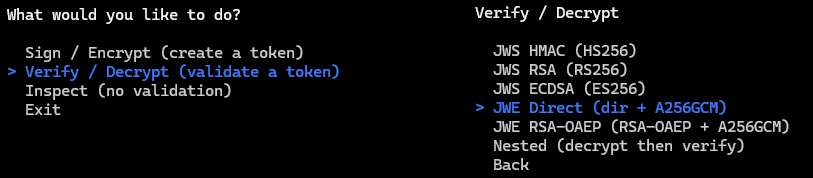
Then paste the token and the secret key to verify it. You can repeat the same process for all tokens below, while choosing the right menu option for each. 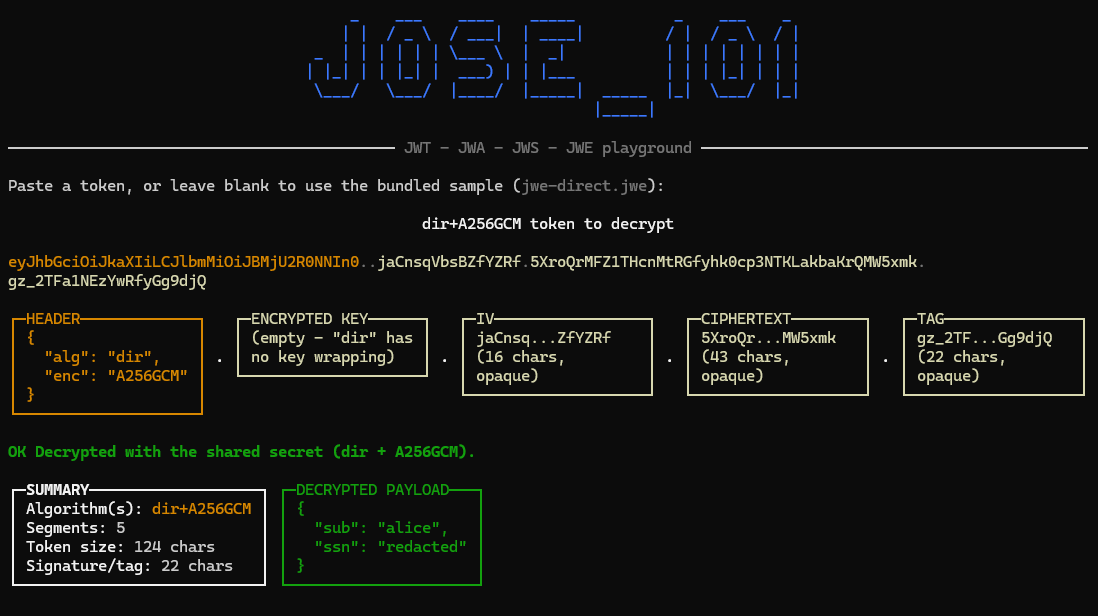
⚠️ Keys are published in the repo so anyone can reproduce the examples, including the RSA private key below. Never reuse them to protect anything real!
dir (direct) + A256GCM - Symmetric
With dir there’s nothing to wrap. The 256-bit key you already share with the recipient is the one used to encrypt the content, so no separate CEK is generated and nothing needs to be carried in the token. Same trust model as HS256: simple, fast, and only usable between parties that already trust each other with the same secret, like we saw earlier.
When to use it: whenever both ends are already inside the same trust boundary. Think two services inside your own infrastructure reading the same key from the same secret store, or an app encrypting its own session state before handing it to the browser and decrypting it on the way back.
Trade-off: all of that assumes the key reached both ends safely, and JOSE says nothing about how it got there. Every party that can decrypt can also encrypt, so a leaked key doesn’t only expose past tokens, it lets an attacker forge new ones your own services will happily accept. The shared key must also be exactly 32 bytes, otherwise it won’t work.
Token example:
💡 Notice the header segment: it ends in ...BMjU2R0NNIn0 and is followed by .., two dots with nothing between them. That empty second segment is dir made visible. There’s no key to transport, so the slot stays there (the five segments are always five) but carries nothing.
Shared secret key:
Implementation:
RSA-OAEP + A256GCM - Asymmetric
With RSA-OAEP (Optimal Asymmetric Encryption Padding), a fresh random 256-bit CEK is generated for this single token and used to encrypt the payload. That CEK is then encrypted with the recipient’s public key and placed in the second segment, so only the matching private key can unwrap it.
When to use it: whenever the sender shouldn’t need any secret of yours. Think a partner system that needs to send you data only you should read, using a public key you published, or an identity provider issuing tokens whose claims are sensitive enough that only the intended recipient should see them.
Trade-off: you pay for that reach twice: an RSA operation on each end, and a noticeably bigger token, since the wrapped key now has to travel inside it. And if the private key ever leaks, every token ever sent to that recipient becomes readable, since RSA-OAEP has no forward secrecy.
💡 Standard RSA-OAEP uses SHA-1 throughout, which is deprecated. Prefer RSA-OAEP-256 (SHA-256 throughout) for new systems.
💡 The pinning rule from part 1 applies here too, now with two headers to pin: the recipient must declare both alg and enc up front, so a token declaring anything else is rejected instead of dictating how it gets decrypted.
That’s the mirror image of signing we’ve seen before, but while in JWS, the private key signs and the public key verifies, in JWE, the public key encrypts and the private key decrypts, so anyone can send you a token only you can read.
Token example:
💡 Compared to the dir token, nearly all the growth landed in the second segment, which is now carrying the wrapped CEK.
RSA Private key:
Implementation:
Same claims, two encryptions
Both tokens above encrypt the exact same payload with the exact same enc. Only alg changed, so here’s where every one of those 349 extra characters went:
| Segment | dir | RSA-OAEP |
|---|---|---|
header | 39 chars | 46 chars |
encryptedKey | empty | 342 chars |
iv | 16 chars | 16 chars |
ciphertext | 43 chars | 43 chars |
tag | 22 chars | 22 chars |
| Whole token | 124 chars | 473 chars |
The iv, ciphertext and tag rows are identical, because those three are produced by enc, and enc didn’t change. The only rows that changed are header, which just carries a longer alg name, and encryptedKey, which is where alg does its real work.
That’s the alg vs enc split from the JWA section, showing up in bytes.
And those 342 characters should look familiar: it’s the same size as the RS256 signature we’ve seen earlier. Same cause, an RSA 2048 operation. Whether RSA is signing a hash or wrapping a key, what it produces is the same size, and that’s the price you pay for not having to share a secret beforehand.
⚠️ Notice that the ciphertext is 43 characters in both, which decodes to 32 bytes, exactly the length of the JSON it hides. Authenticated encryption protects the content, not its length. If your claims vary meaningfully in size, a passive observer still learns something from the token’s size alone.
💡 Rule of thumb:
- Use
dirwhen both ends already share a secret, the same situation where you’d reach forHS256. - Use
RSA-OAEPwhen the sender only knows your public key.
And remember, encrypting is not signing: a JWE proves the content wasn’t modified, not who sent it. When you need both, you nest them, and that’s exactly what comes next.
Nested JOSE: sign then encrypt
Now, you’ve reached the final and most advanced topic, and it builds on every concept we’ve seen through the series.
Nesting is not another algorithm, it’s a technique for getting confidentiality and authenticity at once.
How it works: nest them with the following steps:
- Sign the payload first to produce a JWS.
- Encrypt that entire JWS as the payload of a JWE.
The result is a regular JWE on the outside, so the recipient decrypts it first and finds a JWS inside. Verifying that inner signature completes the chain: confidentiality from the outer layer, authenticity from the inner one.
💡 One detail makes this work by convention: the outer JWE header carries "cty": "JWT", telling the recipient that the decrypted content is itself a JWT (the inner JWS), and should be parsed and verified, not treated as a final payload.
1
{ "alg": "dir", "enc": "A256GCM", "cty": "JWT" }
When to use it: whenever you need both guarantees together. Think an identity provider issuing tokens whose claims are sensitive AND whose issuer must be verifiable, or an inter-service message that must be private in transit yet provably from the right sender.
Trade-off: you pay both costs. Two sets of keys to manage (signing keypair + decryption key), two operations on each end, and a bigger token.
- You also have to pick the right order: sign then encrypt (as done here) hides the signer’s identity from anyone but the recipient.
- The reverse (encrypt then sign) reveals who signed but not what.
- The recipient must check the outer
cty:JWTand verify the decrypted content as a JWT, or nesting is worth nothing.
Token example:
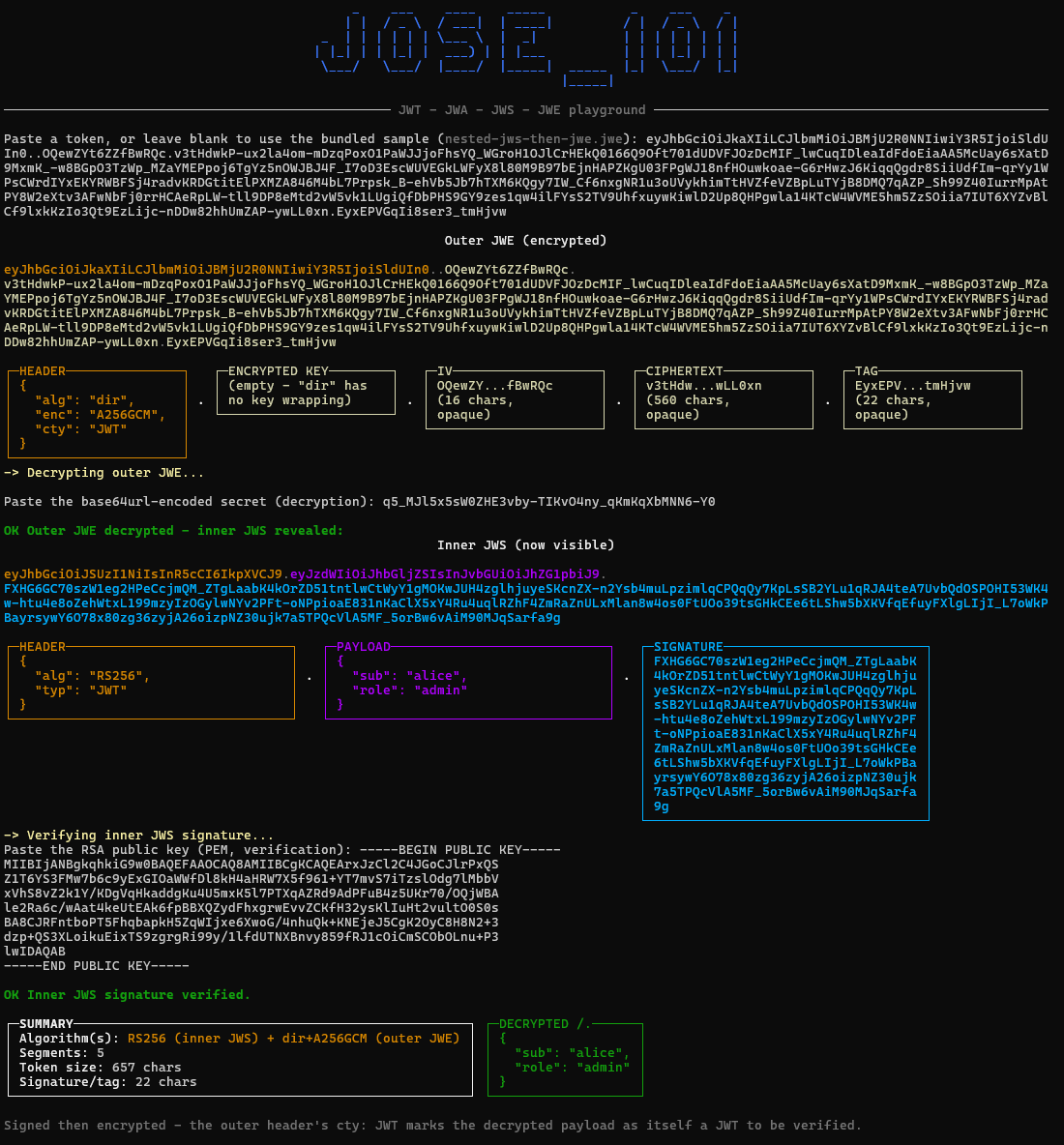
This sample was created with RS256 for signing (inner JWS) and dir + A256GCM for encryption (outer JWE).
From the outside it looks like any dir JWE, with the same .. empty encrypted-key slot. The difference is in the header: that extra cty field, and a much larger ciphertext segment, because the payload being encrypted is now a full JWS (header, payload, and RS256 signature included).
To unwrap it using the app, choose the menu options in the following order:
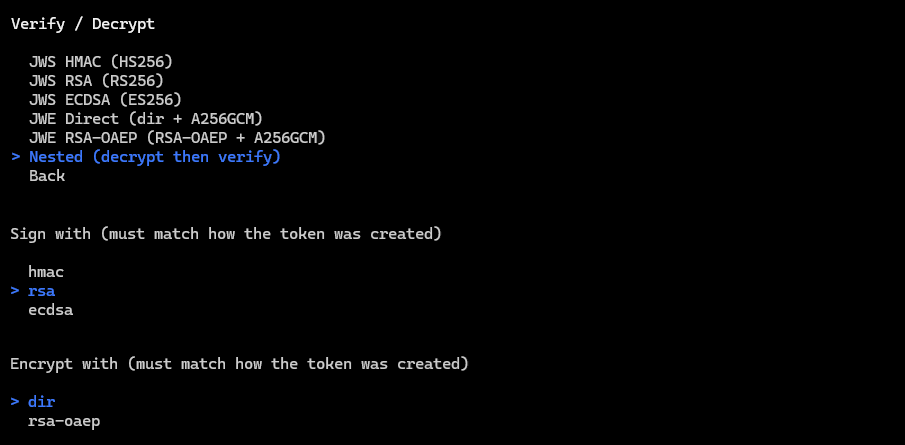
Decryption key (outer JWE, dir):
Verification key (inner JWS, RS256):
Implementation:
💡 The combination above is just one example. The app lets you mix any signing algorithm (HS256, RS256, ES256) with any encryption algorithm (dir, RSA-OAEP), so you can explore all six combinations and see how each one affects the token size and the keys involved.
If you followed the steps correctly, you should see this workflow:
Final thoughts
We finally made it. Although this series is only a didactic subset and an entry point to these concepts and techniques, I’m sure it’s more than enough to get you started.
Across both parts, I covered JWT, JWA, JWS and JWE in .NET, from signing with HS256, RS256 and ES256 to encrypting with dir, RSA-OAEP and A256GCM, and nesting both. Keep the trade-offs in mind when choosing an algorithm or encryption technique, considering both business and technical requirements.
I also recommend you take a look at:
RS384/RS512,PS256/PS384/PS512, andES384/ES512, the higher-security and modern-padding signature variants mentioned in part 1.RSA-OAEP-256, theSHA-256variant of the key wrapping we used here.JWK/JWKS, the standard formats for publishing and rotating the keys themselves.
Thank you for making it this far, and see you next time!
Links worth checking
- RFC 7515 - JSON Web Signature (JWS)
- RFC 7516 - JSON Web Encryption (JWE)
- RFC 7517 - JSON Web Key (JWK)
- RFC 7518 - JSON Web Algorithms (JWA)
- RFC 7519 - JSON Web Token (JWT)
- jwt.io - decode and inspect tokens in the browser
- JWKS - publishing public keys for verification
- jose-jwt